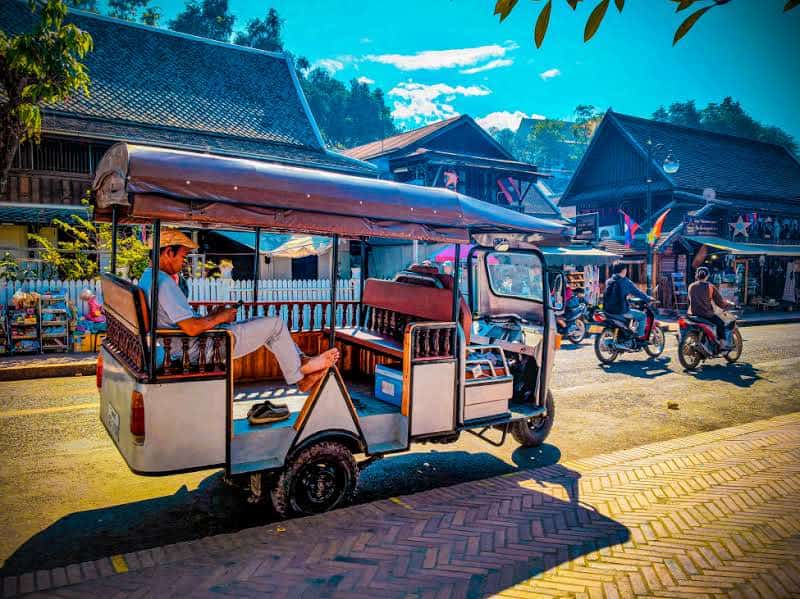
4 Days in Laos | Vientiane and Luang Prabang
I wasn’t planning on going anywhere at the end of the year. I’d just returned from Peru, and travel fatigue had set in. But work is light in December, and it feels almost criminal not to use the lull to sneak in a small adventure. Leave is hard to get anyway, so why not just go when you don’t actually need to ask for it?
So, I booked a quick trip to Laos—just four days covering Vientiane and Luang Prabang. It was a whirlwind, as you can imagine. What follows is a guide on how to do Laos in a short burst, covering all the essentials. Laos is a wonderful country with a unique culture, but I’d recommend it only for the advanced traveller who has already visited Vietnam and Cambodia (in that order) and wants to complete the set.
Laos, Cambodia, and Vietnam are part of the geographical region known as Indochina. Read my earlier itineraries of Cambodia and Vietnam.
About
Laos
Laos’ history stretches back hundreds of years. A lot of countries and factions seemed to have migrated and controlled various parts of the country over the years, and it was difficult to keep track as the guides told stories. But I will try to summarise.
About 4,000 years ago, the knowledge of rice cultivation came to the Mekong from China, leading to the development of the first settled civilisations in Laos. As the era of recorded history begins, we see the rise of Prince Fa Ngum. Having grown up in exile in Cambodia, he came with a Khmer-backed army and by 1353, had founded the Kingdom of Lan Xang, the ‘Land of a Million Elephants,’ with its capital at Xiang Thong (modern-day Luang Prabang). He also brought in Theravada Buddhism, which remains the cornerstone of Lao culture today.
In 1563, the capital was moved to Vientiane to escape Burmese attacks. Soon, succession disputes split the kingdom into rival principalities. By the 19th century, Siam (Thailand) dominated central and southern Laos, while Vietnam controlled the north. In 1893, France forced Siam to cede territories east of the Mekong. Luang Prabang became a French protectorate, while the rest of Laos was administered directly. Laos finally gained its independence from the French in 1954.
The mid-20th century was a turbulent era dominated by the ‘Three Princes’ and their rival political factions amidst an ongoing civil war. Kaysone Phomvihane ultimately brought calm to the storm, becoming the ‘architect’ of modern Laos. In 1975, he led the movement that abolished the 600-year-old monarchy, making way for the establishment of the Lao People’s Democratic Republic, with Phomvihane serving as its first Prime Minister. President Thongloun Sisoulith leads the nation today and is widely considered a key driver of the country’s modernisation. He is the architect behind the Laos-China Railway project that has transformed regional connectivity.
Laos is a relatively small nation with a population of less than 8 million people. It is landlocked between Thailand, Vietnam, Cambodia, Myanmar, and China; its landmass is only slightly larger than that of the United Kingdom. Much of the country is defined by rugged, mountainous terrain, and many communities remain rural, relying on subsistence farming as their primary source of income.
Overall, Laos is not a wealthy country, and several factors contribute to its economic struggle. Being landlocked has historically made international trade more expensive and difficult compared to its neighbours with sea access. Furthermore, the country is still dealing with the devastating legacy of being the most heavily bombed country per capita in history, and millions of units of unexploded ordnance (UXO) still litter the countryside, preventing safe agricultural use of the land. In more recent years, while the Laos-China Railway and various hydroelectric dams have been built to modernise the economy, they have also left the nation with significant foreign debt and high inflation, which continues to impact the daily lives of its people. I noticed signs of many such ‘projects’ with countries like Japan, Thailand, Korea, and Vietnam, as well as with its former colonial master, France.

The Two Capitals
The capital of Laos, Vientiane, is also one of Asia’s smallest capitals. It has a population of less than a million people. While it’s a place where locals go to work and study, Vientiane doesn’t feel like a major metropolis, with the only exceptions being its wide, sweeping boulevards and the occasional pulse of city traffic.
The erstwhile capital, Luang Prabang, is one of the oldest and most historically important towns in Laos. In 1995, UNESCO declared it a World Heritage Site. Luang Prabang has a population of ~60,000 people, though the wider district has more. The town is compact and sits at the meeting point of the Mekong and Nam Khan rivers, surrounded by mountains.
Most tourists and bloggers recommend Luang Prabang as a must-visit while openly stating their dislike for Vientiane. I beg to differ. I liked both, and I think (at least) both are essential to completely understanding Laos.
Vientiane shows you what a growing country looks like and where it might be headed; it feels lived-in and developing. The locals here feel like “real” locals, actively shaping the nation’s future.
Luang Prabang, protected by UNESCO, feels carefully preserved and polished, catering to a Western idea of a vintage city. It often comes across as a postcard version of Laos, almost like how Ubud in Bali felt to me.
As a side note, I was struck by the sheer number of French tourists in Laos. The country was once a French protectorate; however, not many locals speak French anymore, so I wondered if the high volume of visitors is driven by a sense of colonial nostalgia or simply a fondness for the shared history that still lingers in the architecture and the bread.
Best Time to Visit
November to February is the cool, dry season and the best time to visit. In December, when I visited, temperatures in both Vientiane and Luang Prabang ranged from 20–30°C, though it felt noticeably cooler in Luang Prabang. Avoid May to September, the rainy season; though landscapes are lush, the weather can be difficult. Definitely avoid the hot season from March to April, when temperatures can cross 35°C.
Travelling from India
Flights
Currently, there are no direct flights to Laos from India, meaning most routes require a long layover in Bangkok (Thailand) or another major Asian hub (Hanoi – Vietnam is another favourite). Because of this, overall ticket prices can be high, with a standard return route (Mumbai > Vientiane > Luang Prabang > Mumbai) typically costing around INR 40,000.
Since Thailand is currently visa-free for Indians, I decided to turn the necessary layover into part of the adventure. By choosing trains over certain flight legs, I managed to keep the total cost within the INR 40,000 budget while also having a bit of fun.
My Efficient (and Fun) Route:
- Mumbai to Bangkok: Flew in and spent a day enjoying the city.
- Bangkok to Vientiane: Instead of flying, I took the overnight train. This was convenient, saved on a night’s accommodation, and was a great experience.
- Vientiane to Luang Prabang: Travelled via the new high-speed train.
- Luang Prabang to Mumbai: Flew back via Bangkok and Kolkata.
This “hybrid” routing turned out to be the most convenient in terms of timing. It allowed me to see three distinct places without the exhaustion of back-to-back flights or endless airport layovers.
Visa
The Thai visa is free for Indians for a Thailand layover, so you can step out into Bangkok easily. For Laos, you need a visa, and it’s fairly expensive. You can apply online, and it usually arrives in your inbox within three days.
Indian passport-holders are eligible for the Laos e-Visa (online) or a tourist Visa on Arrival (VoA). For the e-Visa, you need to upload the passport biodata page + a recent passport-style photo (white background) + travel details + pay the fee online. The e-visa fee was a whopping USD 51.75 (INR 4600).
Common wisdom would suggest that an e-Visa would make entry processing faster than a Visa on Arrival (VoA). However, at Vientiane’s Khamsavath Train Station, where I landed from Bangkok, both were handled at the same window and took about the same amount of time (which, in the grand scheme of things, wasn’t actually too long). After submitting the printout of your visa approval letter, you are required to have your photo taken before finally receiving your entry stamp. It took about thirty minutes in total to be processed.
Currency
The local currency is Lao Kip (LAK) and symbolised as ₭. The exchange rate is roughly 22,000 LAK = $1 USD and 240 LAK to 1 INR.
It is essential to carry cash in Laos. And since I’ve become so accustomed to digital payments, I often forget to carry a wallet at all; doing so in Laos felt like a chore. While Laos has a local version of UPI/QR payments (called LAO QR or OnePay), I don’t believe foreigners can use it without a local bank account.
Most places do not accept cards, and those that do typically add a 3% surcharge. ATMs are available but come with limits; for example, BCEL (the most common bank) caps withdrawals at ₭2,500,000 per transaction and charges a fee of ₭20,000 to ₭30,000 per transaction. Because of these per-transaction fees, it’s most efficient to withdraw the maximum amount each time.
For my four-day trip, with flights, accommodation, and tours already paid for, I spent approximately ₭3,250,000 (around USD 150). This covered meals, local transport, the night market, and various entrance fees.
Other Tips
- Most temples (and Luang Prabang’s National Palace) require covered shoulders and knees. Check the dress code to avoid having to wear communal clothing. Also, respect the monks. Do not take photos without checking first.
- Most temples and monuments are open from 8:00 AM to 5:00 PM. Some also close for lunch. Double-check the timings.
- Entry charges differ between locals and foreigners, and most of the monuments visited in this itinerary charge ~₭30,000.
- Actual supermarkets are rare. If you find one, stock up on whatever you need. Mom and pop grocery stores are more commonplace, and they all mostly only take cash.
- Buy your souvenirs at the Night Markets; these markets are generally better than those in other countries. While you can (and should) bargain, keep the local attitude in mind: Bor pen nyang (no worries). Most vendors are laid-back, and they’ll act like they don’t care if you buy or not, so bargaining will only get you so far.
- Lao food can be surprisingly spicy, and their sticky rice is unique, not like the Thai variety you might be used to. It’s best to try a small amount before you confidently order a large portion.
- The Toilet facilities can be dirty, so carry your own toilet paper. On the bright side, they almost always have “bum guns” (jet sprays)!
- Free water refill stations are common throughout the main towns (in cafes and museums, primarily), making it easy to stay hydrated while reducing plastic waste.
- Beerlao is practically the national religion. It’s good beer, incredibly cheap (around ₭20,000–30,000 for a large bottle), and is served anytime, all the time. Don’t fight it.
- Cities wake early and sleep early. By 8-9:00 PM, roads and restaurants begin to clear out and shut down by 10:00 PM.
- The official website for tourism in Laos is this one | The official website for tourism in Luang Prabang is this one
Where to Stay
Vientiane: Xaysomboun Hotel & SPA. The hotel is inexpensive and well-located, about a 10-minute walk from most places, but on a quiet street. My room even had a bathtub! There’s a nice restaurant right next door, which makes eating easy, which is useful in Vientiane, where supermarkets are not easy to come by. Overall, it was good value for money, and I would stay here again.

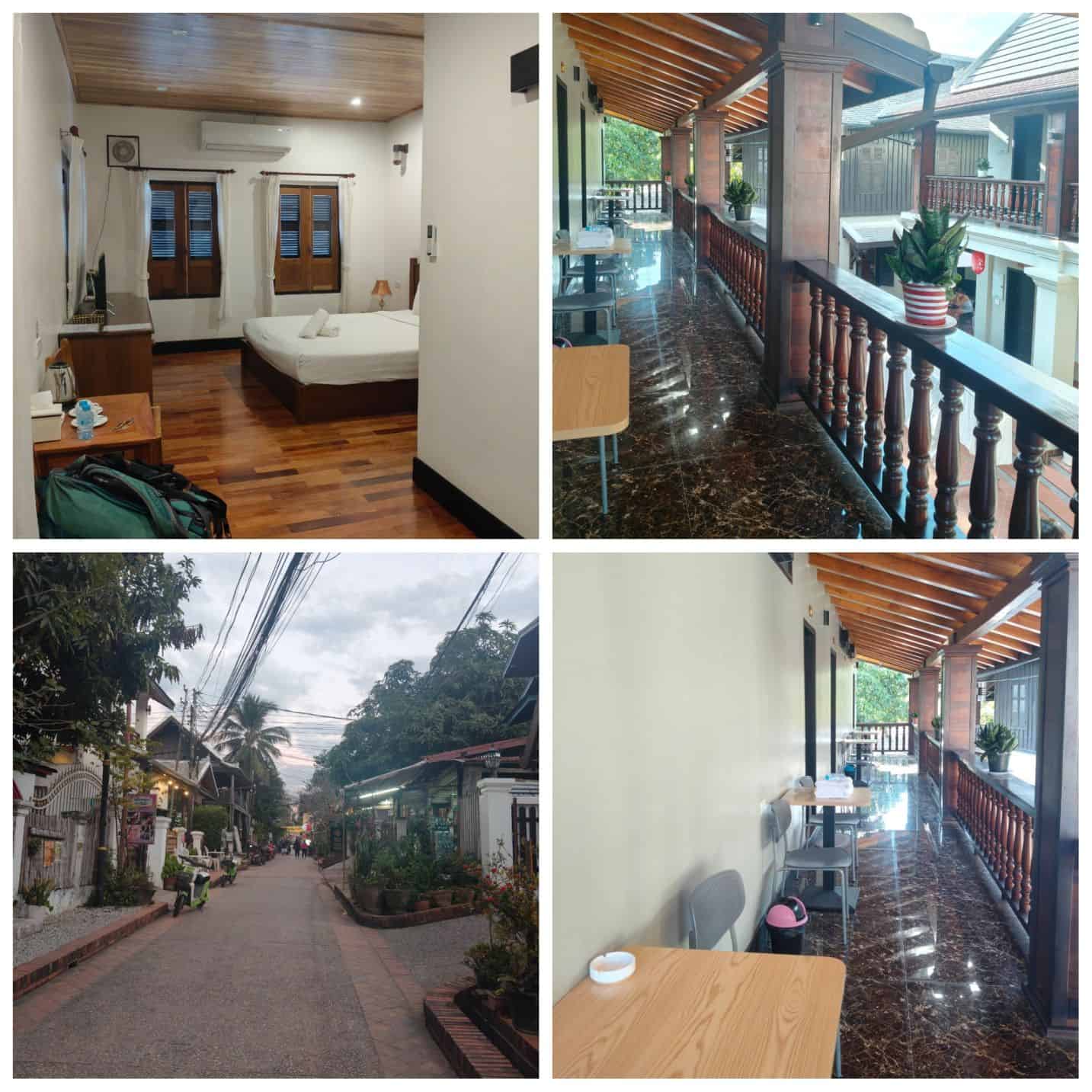
Luang Prabang: Opera Premier Hotel. This is a nice, well-priced hotel close to the centre, tucked away on a quiet street. The rooms are large, well-appointed, and very clean. Breakfast is worth calling out; made-to-order and delicious. The hotel is about a 10-minute walk from the riverfront. I noticed that in Luang Prabang, most hotels look similar in style, which is likely linked to the town’s UNESCO status and the need to preserve its historic fabric. Therefore, ultimately, the differentiator is cost, rather than location or amenities themselves. Almost everything of interest is within a 20-minute walk of most hotels.
- Bi
The Itinerary
Day 1-2: Vientiane
Popular Tours in Vientiane
- Vientiane Landmarks and Cultural Immersion Tour
- 1-Day Vientiane City Adventure: Top Sights & Hidden Gems
Everyone loves to hate Vientiane, but I quite liked it. The city is unhurried and gentle, allowing you to move at your own pace without the pressure of rushing from sight to sight. Using Loca made getting around easy; each trip on a Loca bike cost me less than a dollar. The city boasts wide, clean boulevards dotted with variously-adorned ancient stupas, which makes you want to stop and look, and you won’t have someone bump into your back when you do so. As I walked around, I caught the smoky aroma of Pa Thod (fried fish) sizzling on the sidewalks, making my mouth water, and the scent of Dok Dao Heuang (marigolds) nudged me toward the busy temples. I saw more bottles of Beerlao than I ever thought possible. This place is obsessed with its beer; it practically flows like water.
Vientiane is often called the quietest capital in Southeast Asia, but I would argue it’s the quietest in all of Asia. It is a quirky city—sparse and proud.
Arrival
There are several ways to arrive in Vientiane, the most common being by train or by flight. I arrived by train, and I researched a bit about the flight. Here are the details.
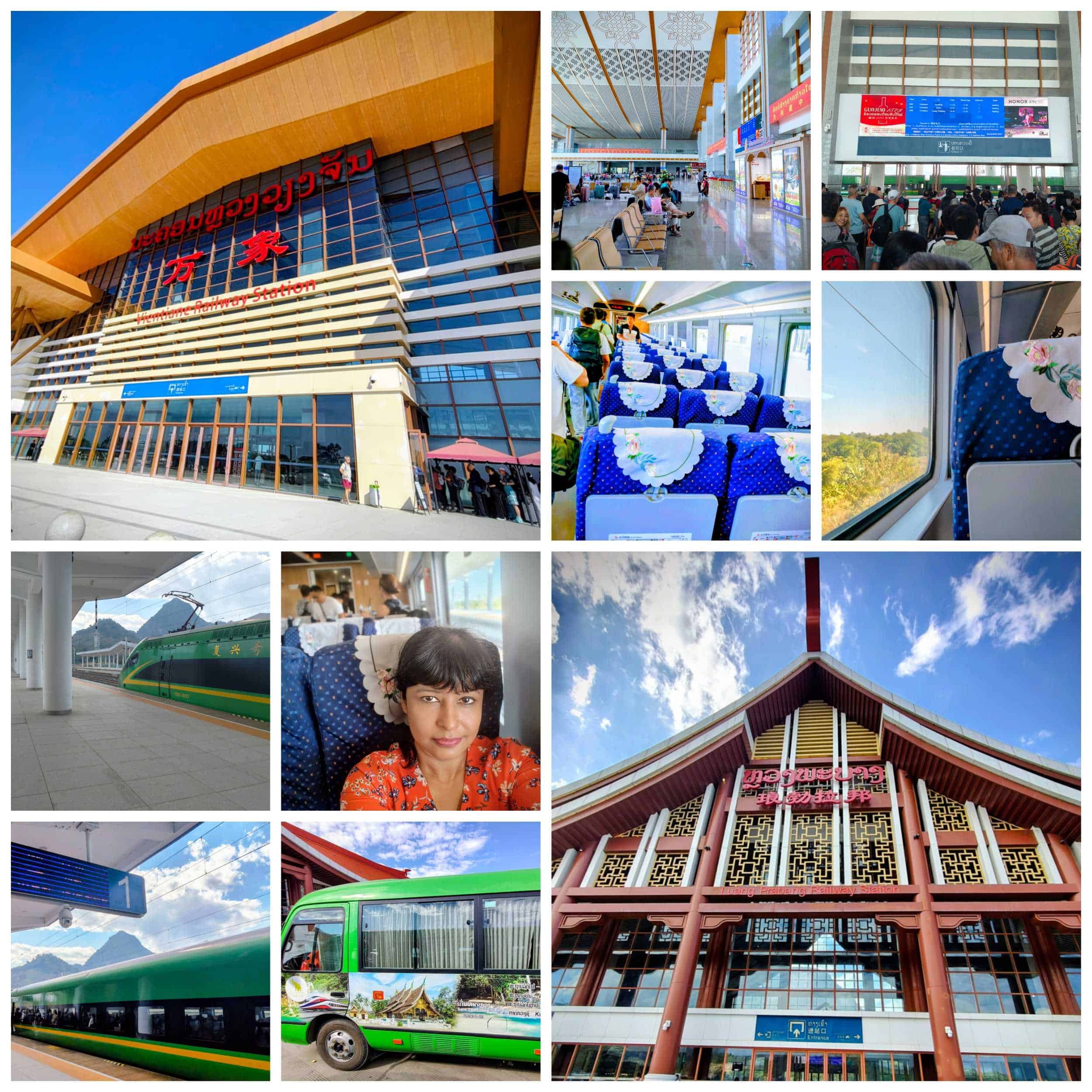
By Train: I arrived at Vientiane’s Khamsavath Railway Station via the overnight train from Bangkok. My experience of the journey is here. The station itself was nothing like the other Asian train stations I had been to, and especially nothing like Bangkok’s Krung Thep Aphiwat Central Terminal from where I had got on. It was chaotic and confusing until I got a handle on where to process your visa and what forms to fill out. It turned out that if you already have an e-Visa, you don’t need to fill out any additional forms—a fact the visa officer confirmed with a smirk as he glibly tossed my paperwork aside. If you have your printed e-visa approval letter, simply join the queue that serves both Visa on Arrival and e-Visa applicants. You’ll then be photographed, your passport will be stamped, and you’ll be sent on your way relatively quickly.
Once you leave the immigration area, you will find SIM card counters outside to your right. I purchased an ETL SIM for about ~₭69,000 (100 THB / ~$3 USD), which felt like a bargain. But the SIM supported 4G connectivity.
Just outside the arrival area, you have the option of taking a taxi or a local bus into the city, but I decided to use Loca. The trip to the city centre cost roughly ₭145,000 ($7 USD). However, if your hotel is located near the Talat Sao Central Bus Station, the local bus that leaves from the airport is also an excellent, budget-friendly choice. The counter is right in front of you as you leave immigration, to the side of the SIM card stores. It may be going to other drop-off points as well.
At the time of my visit, there were no ATMs available at the train station, so it is wise to have some cash on hand. At least some USD.
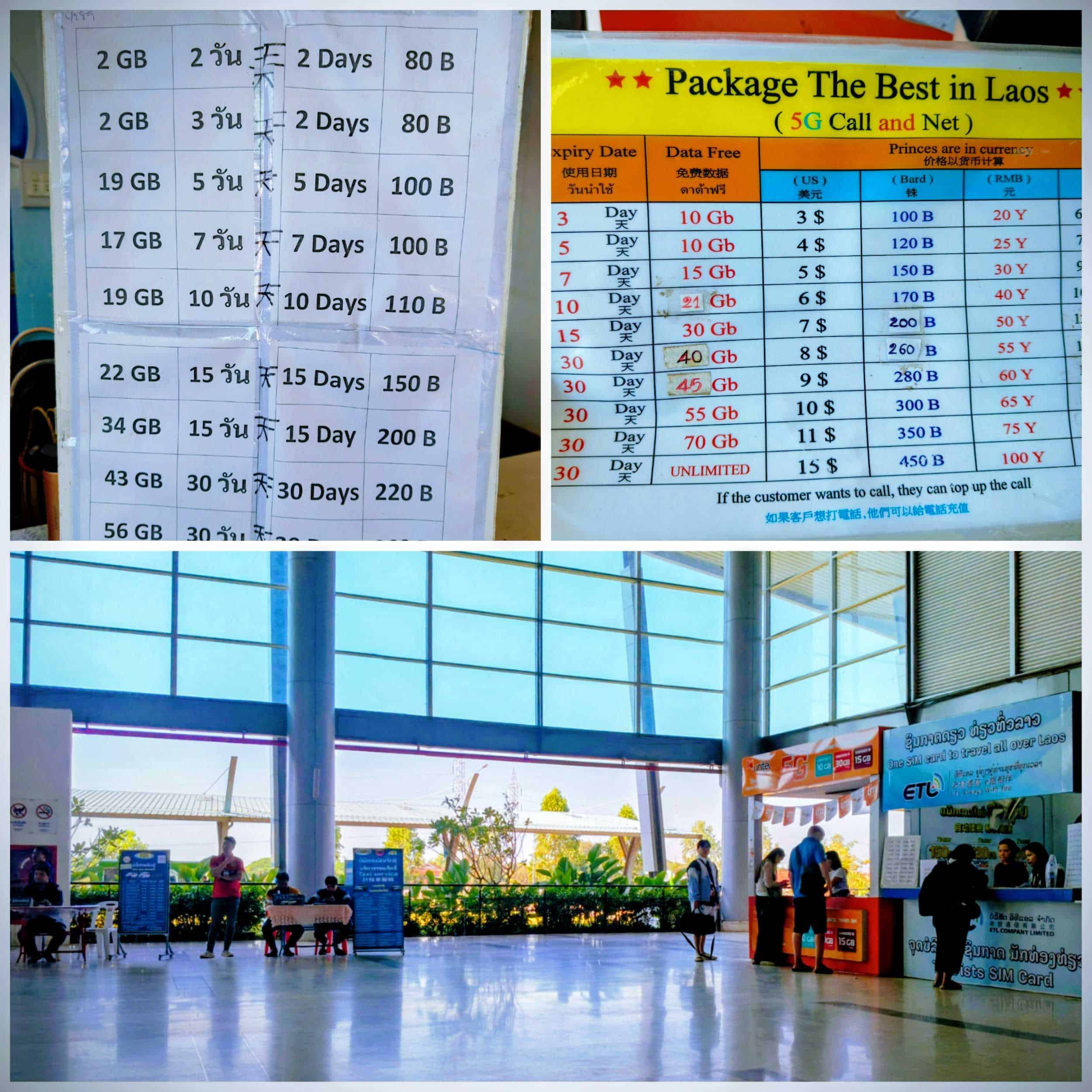
By Flight: Wattay International Airport offers shuttle buses to the city for ₭40,000 per person. One can also use the Loca app from the airport to the city; it doesn’t cost much. The same SIM card options are available at the airport, too. While I didn’t land at Wattay, I saw the arrival area at Luang Prabang Airport, and it looked tiny. I’m not sure if it’s the same in Vientiane.
ATM Information: ATMs are available at the airport and throughout the city. Most have a maximum withdrawal limit of ₭2,500,000 per transaction. Expect transaction fees to range between ₭20,000 and ₭40,000, regardless of whether you are withdrawing at the airport or in the city centre.
Moving Around
I used the Loca ride-hailing app to move around in Vientiane. It wasn’t as efficient or cheap as Bolt in Bangkok, but it worked well enough. I mostly used their bikes as a pillion, but they also have cabs; I used one from the train station to my hotel. Most rides within 3–4 km cost ₭30,000–40,000 (under $2 USD). One thing to keep in mind, though: the app often shows a lower fare initially, then updates to a slightly higher final amount. The increase is usually around 10–15%, so it isn’t too dramatic, but it is good to anticipate it. Some of the bikes also carry a helmet for the pillion rider, though not all do.
Vientiane’s roads are quiet and unhurried, which makes bike rides feel safe and manageable. That said, you can walk to most places in the city. Distances are short, traffic is light, and the pace is slow.
An alternative to Loca in Vientiane is inDrive and Xanh SM.
The Temples
Most temples in Vientiane are open from 8:00 AM to 5:00 PM, though some close for a lunch break. Entry is sometimes free but often ₭30,000 for foreigners. Visitors are required to dress modestly by covering their knees and shoulders, and to remove shoes, hats, and sunglasses before entering the temple buildings.
Some of the temples worth checking out are:
Wat Si Saket: Built in 1818 by King Anouvong, it is considered to be the oldest surviving temple in Vientiane. It is unique because it was constructed in a Siamese (Thai) architectural style, unlike most other Lao temples. This stylistic choice is likely the reason it survived the destruction of the city during the Siamese–Lao war of 1828, when almost everything else was razed. Wat Si Saket has a five-tiered roof, a wooden structure, and the cloister walls hold more than 6,000 small Buddha images made of bronze, silver, ceramic, and wood. The ordination hall has some cool old frescoes. Cost: ₭30,000 (USD 1.35).
Wat Ho Phra Keo (Haw Phra Kaew) was first built in 1565–1566 to house the Emerald Buddha, which was once the most sacred image of the Lao kingdom and is now kept in the Grand Palace in Bangkok. The temple has been destroyed and rebuilt several times, with the present structure dating to 1942, reconstructed by the French. Unlike most temples in Laos, Wat Ho Phra Keo was a royal chapel rather than a monastic temple, so it never housed monks. Architecturally, it blends traditional Lao design with classical Buddhist elements, featuring an impressive staircase guarded by carved nagā (serpents), steep layered roofs, and intricate woodwork. The interior now functions as a museum showcasing bronze Buddha statues, Khmer-influenced carvings, stone jars, and religious artefacts. Fee: ~₭30,000 (USD 1.35)
Wat Si Muang is a 16th-century temple believed to have been built atop a former Khmer-era site. It is historically significant as the home of the city’s “Lak Mueang” (city pillar), which is associated with Vientiane’s protective guardian spirit. Legend tells of a pregnant woman named Si Muang who sacrificed herself centuries ago at the pillar’s site to appease the spirits, leading locals to believe the temple holds a special power for granting wishes.
The temple is architecturally gorgeous and also seems to be a local favourite; it was buzzing with activity when I visited, so great for local people watching. Club a visit to Wat Si Muang with COPE, which is a 4-minute walk away.
COPE
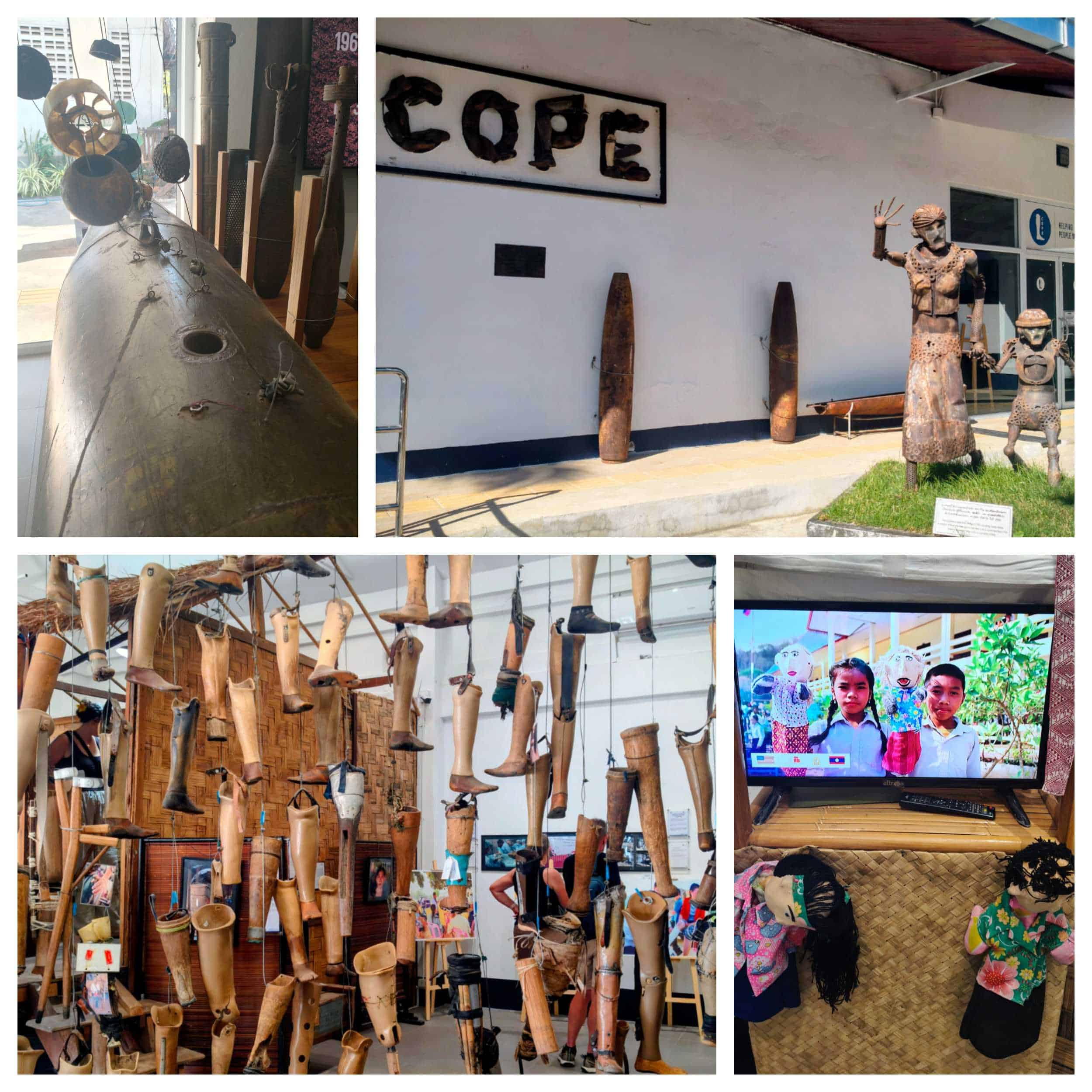
The COPE Visitor Centre houses exhibitions that explain the history and impact of unexploded ordnance (UXO) left from the Vietnam War era. It was sobering to learn that Laos is the most heavily bombed country in the world per capita, and that many patches of agricultural land remain hazardous because of UXO buried underground. COPE works with local communities to provide prosthetics, rehabilitation, and mobility aids to survivors. The centre is worth a short visit; it’s a meaningful experience, though it is slightly out of the way and works best if paired with a visit to Wat Si Muang. Fee: Free | Hours: Daily 8:30 AM to 4:00 PM.
Buddha Park
Buddha Park is a sculpture park 25 km from Vientiane, Laos. When I entered the park, the first thought that struck me was, “Who the heck made this spectacle?” I Googled, then, and found out about the monk-artist, Luang Pu Bunleua Sulilat, who created most of the sculptures in the park starting in 1958. However, after the 1975 Lao Revolution, the new communist government grew suspicious of religious figures like him, and so, he fled Laos and settled in Nong Khai, the Thai border town. In Thailand, he created another large park called Sala Keoku, similar in style but larger and more elaborate. He lived in Thailand until he died. Today, Buddha Park in Vientiane and Sala Keoku in Nong Khai are seen as twin works. What a legacy to leave behind! The sculptures are mind-boggling. He must have been a crazy one to dedicate his life to this.
The Buddha Park in Vientiane has over 200 concrete statues of Buddha and Hindu gods such as Shiva and Vishnu. The main highlights are a large reclining Buddha and a giant spherical structure that visitors can enter. Inside are three levels representing hell, earth, and heaven, and it was indeed hell to make the narrow climb with squealing (older) tourists blocking the path.
The park is open daily from 8 AM to 5:30 PM. Entry fee for foreigners is ₭60,000.

A visit to Buddha Park typically takes about half a day. There is not so much to do in Vientiane otherwise, and this is a good trip to take, especially if you use the local bus as I did, which became an experience in itself and a nice way to travel with locals.
Bus 14 to Buddha Park leaves from Vientiane’s Talat Sao Bus Station. The bus waits until it fills up, which doesn’t take long—and boy, does it fill up. The fare is ₭18,000, and the ride takes about 45 minutes, not including waiting time.
If you want to see the park in relative quiet, aim to arrive around 8:00–8:30 AM, soon after it opens. By around 10:00 AM, bus tour groups arrive, and it gets chaotic. The park is quite small and can be covered in an hour. There are basic facilities on-site, including toilets, a small eating area, and a modest yet well-stocked handicraft shop.
Mekong Riverfront
I headed to the Mekong Riverfront on the very evening I landed in Vientiane. It was a short, pleasant walk from my hotel, taking me through some beautiful, wide boulevards and charming side streets.
However, my first glimpse of the riverfront didn’t exactly leave me enthused. At first glance, it looked a bit unkempt, and the water itself felt far away. Online, I had been promised the spectacle of sunset aerobics, but I couldn’t find any sign of them. Despite that, it was obvious that sunset watching is a favourite local pastime; there were already quite a few people gathering.
By 5:30 PM, everyone had claimed their spots, and the sun began its display. A few monks were out to enjoy the show, and a nearby amusement park started playing throbbing music as a soundtrack to the evening. The spectacle turned out to be quite splendid indeed! There is plenty of space to sit and soak it all in, and you can easily enjoy a beer or two while you watch.
As the sky darkened, the Riverside Night Market began to stir to life on the other side of the road. While it might not be the most high-end market, it is certainly the cheapest place to buy souvenirs. It is said to be open from 6:00 PM to 10:00 PM, but the stores were open well before 6:00 AM. The surrounding streets have plenty of dinner and spa options as well. I picked up a massive fresh juice for ₭30,000 and made my way back to the hotel.

Overall, it felt like a lovely, peaceful, and thankfully unpretentious way to spend my first evening.
Patuxay (Victory Gate)
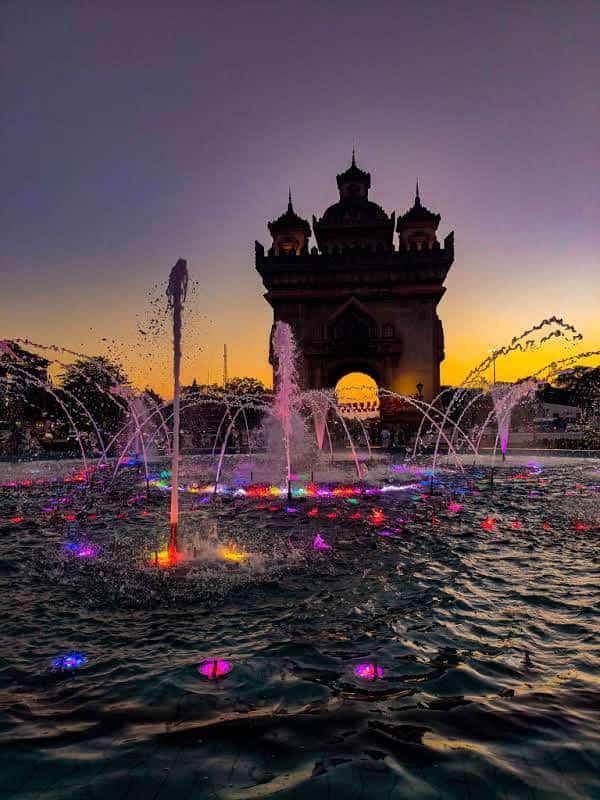
Patuxai, or the Victory Gate in Vientiane, was modelled after the Arc de Triomphe in Paris, ironically to commemorate those who died fighting for independence from the French. It was as if someone took a shortcut and thought, ‘let’s take what they love and make it ours.’ Thus, the interiors are very Buddhist indeed, with lotus flowers, elephants, nagas, and kinnaris all over, while the outside looks like the Parisian original. To add, the structure was built using American cement meant for a new airport, and so now it’s also called the “Vertical Runway.”
Golden hour is the best time to visit, when one can see the transition from dusk to fully lit, with the fountain show doing its grand gig. It is generally open daily, and during the day, one can climb it to see a city panorama for a fee.
The Great Sacred Stupa (Pha That Luang)
Pha That Luang is a bit outside the city centre and requires a Loca bike ride, which costs ~₭30,000. Despite the distance, it is the most important monument in Vientiane and in Laos, and so an effort is required. It is the national symbol of Laos and appears on currency notes and the national seal.
Trivia: Pha That Luang features alongside Kaysone Phomvihane, the first leader of the Lao People’s Democratic Republic, on most high-denomination banknotes (5,000 to 100,000 Kip), while the 2,000 Kip note features the President alongside the Wat Xieng Thong Temple in Luang Prabang.

The history of Pha That Luang mixes legend and recorded history. Local tradition says Indian Buddhist monks came to the area around the 3rd century BC, bringing a relic believed to be part of the Buddha’s breastbone and enshrining it here. A Khmer temple later stood on the site. The first clearly documented stupa was built in 1566 by King Setthathirath, after he established Vientiane as the capital. The monument was damaged during Siamese invasions in the early 19th century and fell into ruin. The structure seen today is largely the result of French restoration work carried out in the 1930s, based on earlier records and drawings. This evolution of the temple is shown in the painting archives on site.
Foreigners pay ₭30,000 to get in, but honestly, there isn’t much to see. There are a few paintings and artefacts that are interesting. However, you can probably take a photo from outside and move on to the temple next door, Wat That Luang Tai, which has a massive sleeping Buddha and a pretty ceiling.
Overall, Vientiane has a big small-town feel. The roads are wide, leafy, and quiet. You’ll notice large government buildings in white and gold, large banks, and wide boulevards, all indicative of a typical communist capital. Traffic signals can be confusing and not always obvious, so I often just followed the locals. There are fewer people and cars on the streets compared to other Southeast Asian cities, making it easy to roam around.
Vientiane Tours are a good idea if you want to see more.
Vientiane to Luang Prabang
I booked my train ticket from Vientiane to Luang Prabang using 12Go. I could’ve used the official app, but domestic ticket sales open only three days before departure, and I wanted to secure mine early to protect my tight itinerary. Even a one-day delay would have derailed my plans. Retail sites like 12Go take a booking request and allocate the tickets once they are released. I’m sure they likely buy tickets in bulk and have some sort of system in place, but I did not delve much into the specifics. They do charge a premium for their service.
While a train is the fastest way to get between Vientiane and Luang Prabang, buses are also an option. You can compare schedules on 12Go or ask your hotel staff. Most local hotels can also book train or bus tickets for you, provided you have a bit of a buffer if tickets are not available on the day you want.
The Laos–China Railway runs several trains a day between Vientiane and Luang Prabang. Prices vary by departure time and class. The 11 AM train worked best for my trip, fitting neatly between checkout in Vientiane and check-in at Luang Prabang, but it was also slightly more expensive.
Getting to the station from the Vientiane city centre to the train station was no problem at all; I simply used Loca to get there, as I did everywhere else in the city. But getting out of the Luang Prabang Railway Station and into the city was a different story altogether, especially because of what I didn’t know then: Loca drivers generally did not pick up passengers there.
As soon as I got off the train at Luang Prabang, I saw everyone rush off to the white and green minibuses parked outside and wondered why they were in such a hurry. I was smug in the knowledge that I had Loca on my phone and could get to the centre easily. However, once everyone cleared off in those minibuses and I began checking the app, a few calls and cancellations later, I realised no car was going to come, and I should have left on one of those minibuses. I was the fool, not them.
I then trudged off to ask the staff at one of the green e-minibuses how to get to the city (the white minibus drivers were quite gruff). I was told I’d have to wait for the next rush of train passengers at 3 PM, nearly two hours from when I disembarked from mine. Luckily, an empty minibus heading to the city took me in.
The journey to the centre took about 20 minutes and cost ₭30,000, dropping me just a ten-minute walk from my hotel. The white minibuses operate as private or shared shuttles and charge a premium for specific drop-offs, whereas the green minibuses serve as the station’s official electric shuttle buses and end at the bus station.
Day 3: Luang Prabang: Inside the City
Popular Tours in Luang Prabang
- Cruise to Pak Ou Caves & Kuang Si Waterfalls (highly recommended. I did this)
- Kuang Si Falls, Forest Hike & Mekong Sunset Cruise
- Mekong Meals Food Tour with 15+ Tastings
- City Highlights Tour
Alms Giving Ceremony
I crawled out of bed at 5:00 AM after a restless, cough-filled night—one of the ‘perks’ of travel sickness—and headed out, half-expecting the streets to be eerie and isolated. But Vientiane had other plans, and I was pleasantly surprised. The road was packed, filled in a way I hadn’t seen even during the day. The sidewalks outside the two neighbouring temples were lined with little red and blue plastic chairs. The air was full of chatter from groups of Chinese tourists already seated on them, as they prepared to unleash themselves on the monks during the Sai Bat (alms-giving) ceremony.
Around 5:45 AM, the monks emerged to receive their offerings. The crowd—a mix of those there to offer alms and those simply there to gawk—stretched for an entire kilometre down the road. I didn’t want to take photos or get too close; I just wanted to observe. Many bloggers urge visitors not to partake in the offering ritual, as it dilutes the sacred ceremony. Honestly, I don’t think tourists taking part is a bad thing; the monks and locals benefit, after all. However, I did wish the noise levels were lower and the sense of reverence higher, as within minutes, I felt the urge to leave for the quieter inner roads. The sheer influx of people—especially the louder tourist groups—does make the whole thing feel a bit “staged,” which is a shame. But it is still a cool experience.
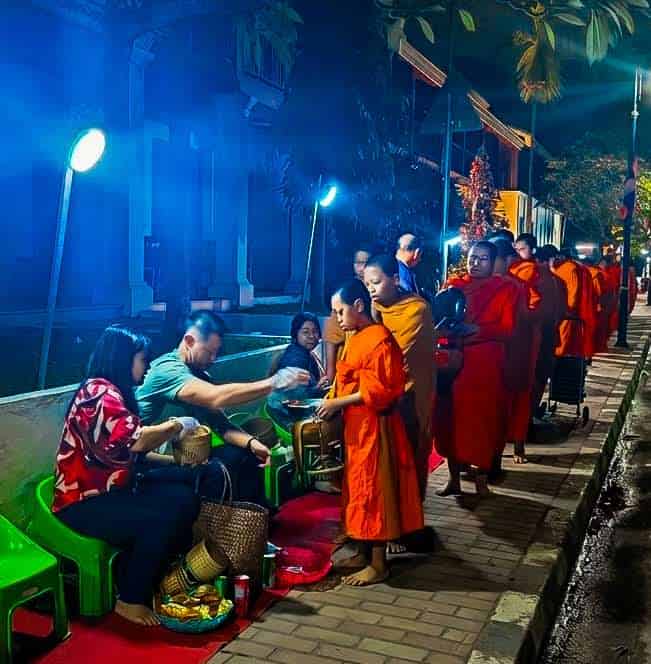
Vendors approached me with baskets priced around ₭50,000, filled with sticky rice, fruit, sweets, and biscuits (no money). I’m told the quality of these baskets can be poor and that monks often discard the food. I didn’t offer any alms, just stood at a distance and took a few pixelated pictures.
If you’re looking for a quieter vibe, the scene at Wat Mai was sedate enough. You could even slip away into the side streets, following a monk or two, to watch in peace. But steer clear of the main stretch on Sakkaline Road near Phousi Hill—it was pure pandemonium there.
Mount Phousi
I was debating going up Mount Phousi for either sunset or sunrise, and while I knew that the former was the more popular choice, I only had two days in the city. Since I was already going to be out for the alms-giving ceremony at 5:30 AM, I decided to climb the hill immediately after it to catch the 6:40 AM sunrise. The timing worked perfectly.
Mount Phousi, which translates to “Sacred Hill,” is considered the spiritual and geographical heart of Luang Prabang. It has watched over the city for centuries and is rooted in local legend as a cosmic centre once said to house a mythical pit leading to the centre of the earth.
I located the front entrance to the climb across from the National Palace quite easily. The path up from this one consists of about 320 steps, and is a relatively easy climb that takes only about 10 minutes to reach the summit. The ticket counter is located a few steps up from the base and opens at 6 AM. I am not entirely sure what happens if you arrive earlier, though it is likely the gate remains open for those wishing to reach the top before the staff arrives. The entry fee is ₭30,000. There is a second, more interesting entry point at the back of the hill near the Nam Khan River. This route is much richer in detail, featuring mini temples and various idols along the way that highlight the hill’s role as a site of active worship and a focal point for festivals like the Lao New Year. If you choose this path, the ticket booth is located midway up the slope. I couldn’t locate this entrance while going up, but I came down this way. While this path offers more to see, many of its features are hidden in deep shadows if you begin a climb in the pre-dawn hours as I did.
On that particular day, the glory of the morning sun remained elusive due to heavy fog. The summit is crowned by That Chomsi, a gilded stupa built in 1804 by King Anourout. While the stupa itself was not especially impressive, I did not mind the company of my fellow sunrise seekers. We were all respectful of one another, sharing a collective sigh when the sun failed to break through despite us giving it ‘five more minutes’. Walking down, I was happily sidetracked by novice monks making breakfast and giggling, alcoves with Buddha relics and a Buddha footprint, and the full weekly roster of Buddhas. The reclining Tuesday Buddha was my favourite. But of course.
Overall, a morning climb right after the alms giving ceremony seems a much better idea than a sunset visit because the air is cooler, the physical effort is easier, and the atmosphere is far more tranquil. During my visit, there were at most 50 people, and everyone was well spread out. The summit is also heavily overgrown with trees, which left me wondering how crowds of tourists could jostle for space to take pictures during the sunset. Luckily, I didn’t have to experience it.
Wat Xieng Thong
I’ve seen my share of Buddhist temples, but Luang Prabang’s Wat Xieng Thong is in a league of its own. I almost didn’t go… because, really, how many temples can you see?… but I had to find out what the fuss was about. Built in the mid-1500s by King Setthathirath, it served as the spiritual heart of the Lan Xang kingdom. Even when the capital moved to Vientiane, Luang Prabang remained the royal seat until 1975, with this temple at its centre hosting royal coronations and major events. Looking at it, it’s mind-boggling to think that its grandeur has survived since the 1500s. The gold stencilling and the intricate artwork on the walls are amazing, but the real showstopper is the rear gable: a stunning glass mosaic of the Tree of Life. Despite the afternoon heat and battling the hordes of tourists, it was well worth the visit.
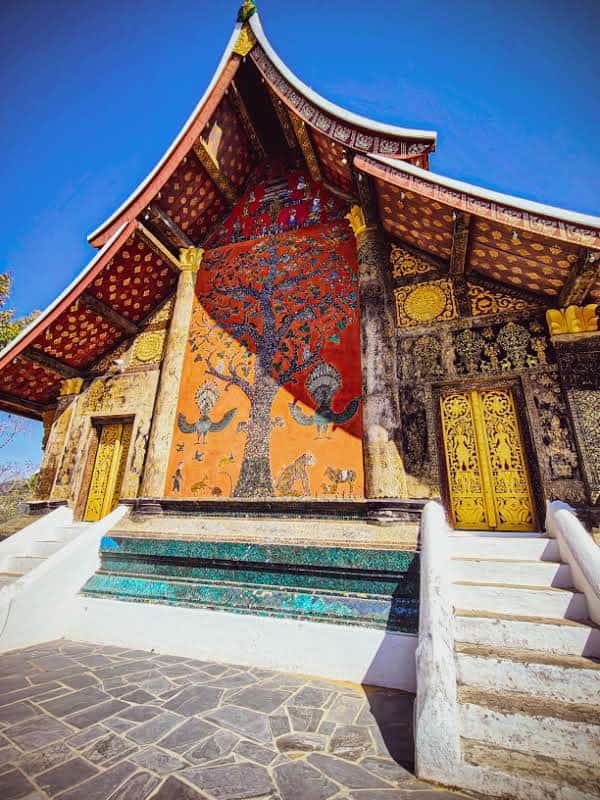
Another temple you will see on the same street is Wat Sensoukharam. It was built in 1718 by King Kitsarath with 100,000 stones from the Mekong River. The name literally means “Temple of 100,000 treasures”. The walls feature red lacquer and gold leaf stencils. Monks live in the quarters behind the main hall and perform daily drums at 4:00 AM and PM. Admission is free, and it’s well worth a saunter inside. It’s beautiful and also quite peaceful.
Royal Palace Museum (Haw Kham)
I know the National Palace is considered a “must-see” in Luang Prabang, but to be honest, my visit was less than pleasant.
Constructed in 1904 for King Sisavang Vong, the compound serves as a vital cultural landmark. It is centred around the Haw Kham (Palace Building), a “Golden Hall” that blends formal reception rooms and a mosaic-adorned Throne Hall with residential quarters preserved as they were in 1975. The grounds also feature the ornate Haw Pha Bang chapel—built specifically to house the sacred Phra Bang Buddha—and a collection of vintage American cars that offer a unique mid-century contrast to the traditional surroundings. Completing the complex are the Royal Barge Shelter and the Phra Lak Phra Lam Theatre, which hosts traditional Lao Ramayana dance dramas.
Be prepared for several strict requirements before you enter. You must dress conservatively (shoulders and knees covered). If needed, you can hire traditional skirts at the entrance. You must remove your shoes before entering the two main buildings and the former Prime Minister’s house. No bags of any size are allowed inside the Prime Minister’s house. Photography is strictly forbidden inside, and the scrutiny is real. I watched guards take phones away from visitors to delete shots.
When the attendant told me about the no-bag policy at the entrance, I had half a mind to walk out and not return. It was sweltering, the grounds were teeming with noisy tourists, and I was feeling overstimulated and tired. However, the ₭60,000 (USD 2.75) entry fee I had already paid kept me there. I figured I might as well see what was inside.
The palace is open 8:00 AM–11:30 AM & 1:30 PM–4 PM (Closed Tuesdays). Try visiting early in the morning or late in the afternoon to actually feel the atmosphere of the place, rather than just feeling the person standing next to you.
A brief side note on the history: the very name of the city originates here. Luang means “royal” or “great,” and Prabang refers to the Phra Bang, the 83cm-tall gold alloy Buddha statue that is essentially the nation’s soul. A gift from the Khmer Empire in the 14th century, it now resides within the palace and only leaves for the most sacred ceremonies.
It was interesting to see the residence of the erstwhile King and Queen. It’s sparse, mostly wooden, with beautiful paintings. Some that stood out were the portraits of the King and Queen, the clothes they wore, and the gifts they received from various countries. I noticed that India, in fact, had a whole cupboard, which was lovely to see. China also had a few impressive ones, and I’m sure that’s why the Chinese tourists were gawking in the hall for such a long time.
I later went for a theatre performance in the Royal Theatre, which cost me ₭150,000 for a seat in the back rows. More about it down the blog.
Traditional Arts and Ethnology Centre (TAEC)
This is a lovely, small museum (just three rooms) focusing on the many ethnic groups of Laos, covering weaving and living styles. Because of its size and lower number of visitors overall, you can slow down and absorb more. The descriptions are clear and easy to follow. Some of the writing is quietly evocative without being heavy. The gift shop has limited but tasteful stock and is not too expensive. There is a café that serves only drinks. You can sit with a coffee and watch movies on local life playing on a TV.
Overall, this works well as a gentle activity, especially good on your last day in Luang Prabang, before a flight. I did that. Details.
Evening: The Night Market & Mekong Riverfront
In Luang Prabang, the evening really centres around two main stretches: the Night Market and the Mekong Riverfront.
The Night Market kicks off around 6:00 PM and stretches all the way until 10:00 PM. It takes over a massive length of the main road, starting near the open-air food court and extending past the National Royal Palace. To be honest, the quality here is far superior to the night market in Vientiane. It’s a fantastic mix of local clothing, unique souvenirs, and high-quality handicrafts, all reasonably priced.
I recommend starting at the food court. It’s a bustling, open-air space with a good number of choices. You can grab a Beerlao and order local specialities, though several stalls also offer surprisingly good Western-style sandwiches. It is well worth spending a good chunk of your evening just wandering through here tasting various delicacies.
Once you’ve finished your loop of the market, head over to the Mekong Riverfront. The stretch of road overlooking the water is beautiful, especially at dusk. There are plenty of superlative cafes and restaurants with a riverfront spot perfect for watching the sunset. Saffron Coffee is a well-regarded cafe. As a side note, Popolo, a pizza place located slightly inside, was always teeming with tourists. Pizza seems to be a popular offering in Luang Prabang.
Trivia: Laos boasts a rich coffee culture rooted in the volcanic soil of the Bolaven Plateau. This unique terrain produces bold, high-altitude Robusta beans, which give the local brew its signature richness. It is traditionally ‘sock-brewed’ and mixed with thick condensed milk (Kafe Lao): a legacy of the French colonial era. For a sense of local costs, a hot black coffee at the ubiquitous Café Amazon chain is just ₭26,000, while a Cappuccino is around ₭32,000.

If you happen to be there during the Christmas season, the atmosphere is truly romantic. The trees are draped with lit-up stars, and the festive lights reflect off the darkening river as the cruise boats begin to dock for the night. It’s the perfect place to sit, sip a coffee or a drink, and just watch the world go by.
While the Night Market stays lively until late, the riverfront restaurants tend to wind down much earlier. By 8:00 PM, I noticed many of them were already starting to close up. Make sure to get your riverfront spot by 5:00 PM or 5:30 PM to catch the full display before the quiet sets in.

The Walk: To get a feel of this UNESCO city, one takes the “Golden Peninsula” walk, starting from the Royal Palace on Sisavangvong Road to the tip where the Nam Khan River meets the Mekong River. Walking northeast, the main street shifts from Sisavangvong Road to Sakkaline Road as you enter the Old Town, a scenic stretch lined with colonial villas, cafés, and major temples. The route ends just past Wat Xieng Thong, at the very tip of the peninsula, where the Nam Khan flows in from the right and joins the Mekong on the left. The distance is about 1.2 km. Walk out along Sakkaline Road, then return via Khem Khong, along the Mekong riverfront, for sunset views and boat moorings.
Day 4: Luang Prabang: Outside the City
I used this spectacular Cruise to Pak Ou Caves & Kuang Si Waterfalls to cover several sights in a few hours, an ideal way to spend (my) Christmas Day. This is what we did.
Hmong Village
Our first stop was a Hmong village, though it could hardly be called that. It was more a collection of ramshackle homes and stalls clearly set up for tourists. The Hmong are a local ethnic group, making up approximately 9–10% of the Lao population. Originating from southern China, they traditionally settled in the high mountains, practising shifting cultivation of rice and maize. Their society is deeply rooted in strong clan structures and shamanic traditions, with a history shaped by the “Secret War” in the 1960s and 70s, during which many were recruited by the CIA to fight the Lao communists.
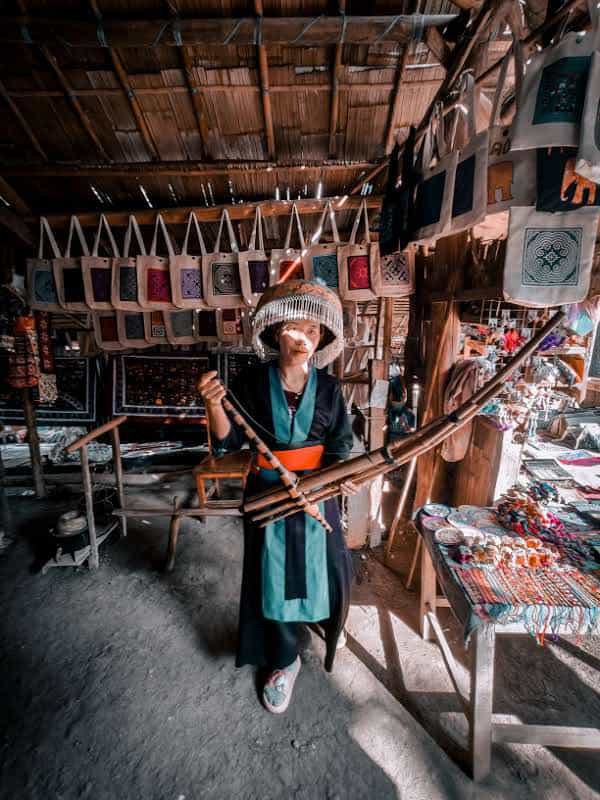
The Hmongs have a 10-day New Year celebration, and a tradition during this time is particularly noteworthy, which is the pov pob ball-tossing courtship ritual. Young men and women stand in two facing lines and toss a small cloth ball back and forth. The slow rhythm creates a reason to talk. It allows flirting in public. If interest grows, the pair may meet again later. Parents dress up their young, especially for this time of the year.
The Hmong today face significant socioeconomic challenges. Educational opportunities remain limited and are often not prioritised over the immediate needs of the household. The population is rising rapidly; currently, over 50% of Hmong women marry before the age of 18 and have an average of six children, which places immense pressure on the community’s resources. It was evident in the visit, although our hostess was exceptionally kind and non-pressurising.
The Hmong Village stop can feel like a bit of a “show,” however, stepping into a traditional home setting was interesting.
Kuang Si Waterfalls
Kuang Si Waterfall is the one place everyone in Luang Prabang (including the locals) told me was an absolute must-visit. And so, my expectations were sky-high. But…
Located about 29 km south of town, it’s (what could have been) a stunning 60-metre water cascade that flows into limestone terraces and creates Insta-famous bright turquoise pools. The beauty is real, but when I arrived, the scene was a complete circus. Since most people arrive on bus tours, the place gets packed between late morning and mid-afternoon, with older tourists and influencers trying every imaginable angle for the “perfect” shot. I saw women dressed in full traditional clothes just for a photo op, jostling with others trying to do the same in no less glamorous ones, men lifting women (hopefully their wives) for romantic memorabilia. Phew, it was wild. And with all the commotion, I barely heard the sound of the waterfall. It reminded me of Plitvice Lakes in Croatia and how disappointed I was in the first hour of my visit, when I wondered if this was all there was, until I discovered the hidden nooks and trails away from the noise. The waterfalls felt more like a theme park than “nature” because of the out-of-control crowds.

Cribbing aside, if you time your visit well, it’s worth going. Entry for foreigners is ₭60,000, which includes an electric shuttle from the gate to the falls; otherwise, it’s about a 20-minute walk. On busy days, there can be a long wait for the shuttle on the way back. Wooden walkways run throughout the site, and swimming is permitted in select pools. There is also a ziplining option, which takes about 1.5 hours. Don’t count on it ending quickly—some fellow travellers underestimated the time and paid for it later.
We had a sumptuous buffet lunch by the riverside at Manifa Elephant Camp, followed by the chance to feed bananas to the elephants for a small fee. The history of Laos is inextricably linked to these gentle giants, once known as the “Land of a Million Elephants,” and seeing them in this riverside setting provided a living connection to the country’s ancient heritage.
Next, we took a boat and visited the Pak Ou Caves.
Pak Ou Caves
Pak Ou Caves are naturally formed limestone caves located where the Mekong and Nam Ou rivers meet, about 25 km from Luang Prabang. The first use of the caves for religious purposes was at a time when the local population worshipped Phi, or the spirits of nature. It is said that the caves are associated with a river spirit. By the 16th century, Buddhism had been adopted by the royal families of Lao, and the caves received patronage from that time until 1975. Every year, the King and the people of Luang Prabang made a pilgrimage to the caves as part of the New Year religious observances. Artisans were commissioned by the royal family to prepare sculptures. Many of the carvings in the cave date from between the 18th and 20th centuries. Today, the site is maintained by the Lao government.
The caves consist of two parts: the lower cave (Tham Ting), which is easily accessible, and the upper cave (Tham Theung), which requires a ten-minute climb. Together, they hold thousands of Buddha statues in different sizes, styles, and ages. The visit itself is fairly quick, and for many people, the boat journey and the story behind the caves are more interesting than the caves alone, though the setting is still worth seeing. The caves are open from 8:00 AM to 5:00 PM, and entry costs ₭30,000 for foreigners.

We had a short stop between the Pak Ou Caves and the Mekong Sunset Cruise at what is known as Whiskey Village (Ban Xang Hai), which, to be honest, was interesting but passable. I don’t know how many such villages exist, but we met one maker of Lao-Lao, the potent local rice whiskey. We heard how it was made and saw the equipment. Was the whole village called Whiskey Village? Were there more people like the man we would meet? I have no clue.
The visit included a tasting of the spirit, though we skipped the more “adventurous” bottles embedded with snakes and scorpions. One of my co-travellers asked how the animals were inserted inside, and the whiskey maker demonstrated with a series of squeezing and breaking motions. Shudders. We didn’t walk around the village—though in hindsight, we should have, as it looked quite peaceful and basic. Even the wooden crossing to the village was a fun (because) wobbly experience.

The not-so-long-ago alcohol poisoning news out of Vang Vieng was definitely on my mind, so I played it safe and opted for the smallest bottle possible as a souvenir. The bottle was too fun to pass up, and at ₭50,000 for a 50% proof spirit, it makes for a great (if slightly intimidating) keepsake.
Mekong River Cruise
After lunch, the mode of travel shifted from road to river. A 30-minute sightseeing cruise on the Mekong River offered a change in perspective. The Mekong is the lifeblood of the region, historically serving as the primary highway for trade, religion, and war. The beauty of the river lies in its muddy turbulence contrasted against the sharp, jagged karst mountains that rise vertically from the banks. The boat cut through the water, approaching the sheer limestone cliffs where the Nam Ou river meets the Mekong.
Watch a Musical
I’ve made it a habit to seek out local theatre and musical experiences wherever I travel. Even if I don’t speak a word of the language, there’s a universal energy to performance that helps you soak in the local rhythm. Plus, as a solo traveller who has traded ‘pubbing’ for quieter evenings, finding ways to fill those post-sunset hours can be a challenge. Theatre has seldom let me down.
Until I arrived in Luang Prabang.
Because, my first try was a total bust. After much looking, I went to a show (Garavek. Honestly, don’t) and left feeling sorely disappointed that a place as culturally rich as Luang Prabang didn’t have more to offer. The next day, while jostling through the crowds at the National Palace, desperately wanting to leave, but with FOMO keeping me there, I noticed a woman selling tickets to a Royal Theatre show. The price was the same as the previous night’s disappointment, so I thought: Why not?

When I settled into the nearly empty auditorium later that evening with my ‘cheapest in the house’ ticket, I had a moment of doubt. Had I blundered again? I didn’t even know what the play was about. Then I opened the flyer, and my jaw dropped. It was Sita Haran (the abduction of Sita), a key chapter of the Ramayana. We grow up reading this.
Even though it had been years since I’d read the legend, the story came rushing back. The next ninety minutes were a joy to behold, a beautiful mix of dance, music, and silent histrionics. Sita was the most elegant, almost fragile version I’ve seen, moving like waves of water and accompanied by her equally delicate attendants. The men, monkeys, and deer scampered across the stage in vivid masks and striking costumes. It was a joyful revision of an age-old story, even though this version of the Ramayana is generously localised. In Laos, it’s called Phra Lak Phra Ram: Lak for Lakshman and Ram for Ram. Simple enough, right?
In the end, it was the perfect redemption for my earlier disappointment.
Tickets: I couldn’t find a way to buy them online, but you can get them at the Royal Theatre entrance at the National Palace. Cost: The cheapest seats were ₭150,000. Schedule: Shows are typically on Monday, Wednesday, and Saturday. Timing: 6:00 PM (High Season: Oct–March) or 6:30 PM (Rest of the year).
Bonus Tip
What to Read for Your Trip: I picked up the delightful first book in the Dr Siri Paiboun series, The Coroner’s Lunch, which had me hooked from start to finish. Although written by British expat Colin Cotterill rather than a local, the narrative feels remarkably authentic. He captures the peculiarities of the Lao people beautifully, weaving together mysteries and gentle humour against a rich historical and political backdrop that brings the setting to life. I loved it and finished it within the trip, which is saying a lot since it was a short trip, and I was always on the move. It does have some supernatural elements, but let that not deter you.
Curiously, I didn’t see many bookstores in either Luang Prabang or Vientiane.
Plot Summary: Despite a total lack of training, an utter dearth of experience, and a complete absence of inclination, Dr Siri Paiboun has just been appointed state coroner for the Lao People’s Democratic Republic. It’s 1976; the royal family has been deposed, the professional classes have fled, and the communists have taken over. And 72-year-old Siri—a communist for convenience and a wry old reprobate by nature—has got the coroner’s job because he’s the only doctor left in Laos. But when the wife of a Party leader is wheeled into the morgue, and the bodies of tortured Vietnamese soldiers start bobbing to the surface of a Laotian lake, all eyes turn to the new coroner. Faced with official cover-ups and an emerging international crisis, Siri will be forced to enlist old friends, tribal shamans, forensic deduction, spiritual acumen, and some good old-fashioned sleuthing before he can discover quite what’s going on…
This is how I plan all my trips quickly and economically. These are my go-to travel planning sites:
- Start at TripAdvisor to explore top things to do and create a rough itinerary.
- Use Viator or GetYourGuide for day tours and experiences.
- Book stays on Booking.com for flexible and cancellable options.
- Get Priority Pass for airport lounge access and smoother layovers.
- Search best airfare deals on Skyscanner. Try the “To: Everywhere” option to discover new ideas.